The theory
Rest-State Inversion replaces the abstract geometry of General Relativity and Quantum Mechanics with the fluid dynamics of one universal medium. These are its central ideas.
Where physics stalls, RSI flows
The standard model and quantum mechanics rely on dark matter, dark energy, inflation, a singular beginning and the collapse of the wave function to close their gaps. RSI accounts for the same observations without contrived mechanisms.
- No Big Bang singularity
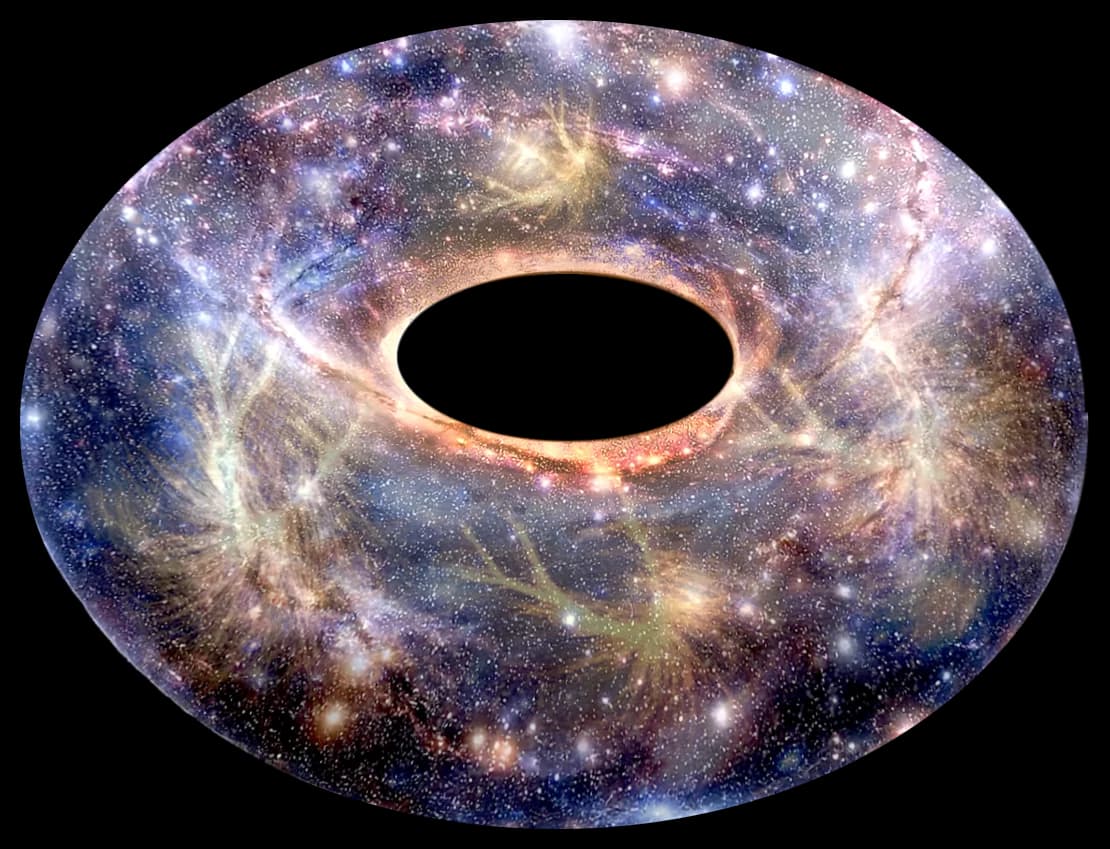
The universe has no explosive beginning where physics breaks down. It is a toroidal cycle; what is called the Big Bang is the Big Break, the current phase of the Exhale.
- No inflation
The sky is the same temperature in every direction because the medium is one substance at one tension, not because of a burst of faster-than-light expansion driven by a field no one has detected.
- No dark matter
Galaxies spin as they do because they are vortices in the medium. No invisible mass is required, and decades of detectors have found none.
- No dark energy
The accelerating expansion is the pressure of the toroidal Exhale as matter thins toward the rim, not an unexplained energy filling empty space.
- No collapse of the wave function
A particle is always somewhere, guided by the flow of the medium. A measurement is an ordinary interaction; nothing collapses and no observer is required.
What RSI explains
The standard model measures these values and takes them as given. RSI gives each one a physical reason.
- Why the double slit makes stripes
Each electron passes through one slit while the medium flows through both and guides it. A path record, not an observer, removes the stripes.
- Why the electron has its mass
One wavelength fitting the double circuit of a 720° loop gives m = ħ / 2rc: 9.109 × 10⁻³¹ kg, the measured mass.
- Why the number 137
The fine-structure constant is the shape of the electron: its loop is 137.036 times its core, so the field's clamp opens once in every 137 core lengths.
- Why the atom is the size it is
The atom's first standing-wave valley lies 137 electron loop-lengths out: 3.86 × 10⁻¹³ m × 137 = 0.0529 nm, the Bohr radius.
- Why the proton is 1836 times heavier
Three loops braided along six axes give 6π⁵ ≈ 1836.12, within 19 parts per million of the measured ratio.
- Why the lepton masses are linked
The electron, muon and tau obey Koide's relation to 9 parts per million: their masses sit exactly 45° from the diagonal of three-dimensional space.
- Why charge comes in thirds
Three loops sit 120° apart, so quarks carry ⅔ and ⅓, and the proton's charge exactly balances the electron's.
- Why the medium has a heartbeat
The medium completes one cycle of bending and release per Planck length: c / lₚ ≈ 1.85 × 10⁴³ beats per second, the clock behind every tick and every decay.
- Why the forces are one
One tension, 0.73 N, becomes the strong force's 8.23 × 10²⁸ Pa at the proton's surface and bends starlight by 1.75 arcseconds at the Sun.
- Why half-lives never change
A decaying knot has the same small chance of re-twisting on every beat, set by constants no laboratory can disturb. That gives decay its exact exponential law.
- Why the muon's magnetism runs slightly strong
A fluid knot slips a little on each turn through the 137-escapement. That slip, α / 2π ≈ 0.00116, is the correction Schwinger derived in 1948.
- Why gravity travels at the speed of light
Gravitational waves and light are waves of one medium, so they cannot travel at different speeds, as the GW170817 merger confirmed.
- Why the universe is made of matter
The handedness of the toroidal flow meets all three of Sakharov's conditions for a matter surplus, using structure the theory already has.
What RSI predicts
Tests an experiment can confirm or refute.
- The flow continues past Shapley
The bulk flow of galaxies should not fade beyond the Shapley Supercluster. Cosmicflows-4 now points this way.
- The Muon Shadow Test
Muons moving through dense matter should live slightly longer than muons at the same speed in open space.
RSI calibrates its medium with one measured input, the electron's rest energy and radius. The questions it is still working on are listed openly in Research in progress.
The central ideas
- The Eternal Consonance
The universe is not an empty vacuum but a single incompressible universal continuum with no constituent parts. Light, matter, gravity and charge are all behaviors of this one medium.
- The 0.73 newton tension
RSI derives a finite vacuum tension of about 0.73 N from the mass of the electron. Together with the medium's linear density of 8.12 × 10⁻¹⁸ kg/m, it sets the speed of light, c = √(Ξ / μ).
- Matter as a knot
A particle is a wave that has looped back on itself and locked with a 720-degree double twist. In RSI, matter is a knot of kinetic energy waves, held in check by the tension of the field.
- The 137-Escapement
The fine structure constant, about 1/137.036, is read as the escapement ratio that governs how matter knots exchange energy with the field.
- The proton's mass
The proton is a braid of three nested vortices. Its packing geometry gives a mass ratio to the electron of 6π⁵ ≈ 1836.118, close to the measured 1836.152.
- Quarks, neutrons and charge
The proton's three loops are its quarks. Seen along the braid's axis they sit 120° apart, so charge comes in thirds: +⅔ for an up loop, −⅓ for a down loop. The loops mesh at the Shadow Junction, the binding physics calls the gluon. The neutron is the same braid with the opposite majority, and its charge cancels to zero.
- One tension, four forces
The strong force is the field's compression at the proton surface, 8.23 × 10²⁸ Pa. Electromagnetism is the 137-cycle escapement. The weak force is the steady failure of dissonant knots, a fixed chance on every beat. Gravity is a refractive gradient that bends starlight by 1.75 arcseconds.
- Time as mechanical fatigue
The medium beats at about 1.85 × 10⁴³ cycles per second. Time is the irreversible record of events that matter accumulates against that beat, which is why it runs in one direction only.
- No dark matter, no dark energy
Flat galactic rotation curves are the quantized vorticity of the universal continuum. Cosmic acceleration is the pressure of the toroidal Exhale current.
- The toroidal universe
Under its own tension the medium organizes into a closed vortex ring. It exhales from a Still Core, rolls over an outer rim and inhales, a steady-state cycle with no heat death.